 Add to Chrome
 Add to Firefox
 Add to Edge
Magnetic induction tomography
Papers and Code
MITNet: GAN Enhanced Magnetic Induction Tomography Based on Complex CNN
Feb 16, 2021
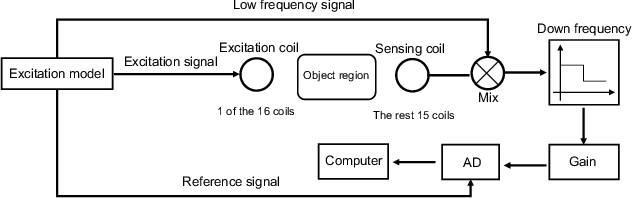
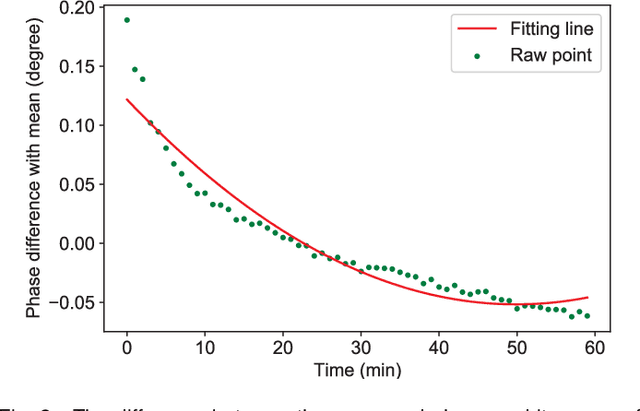
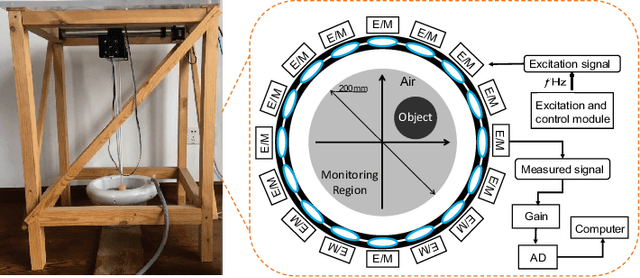
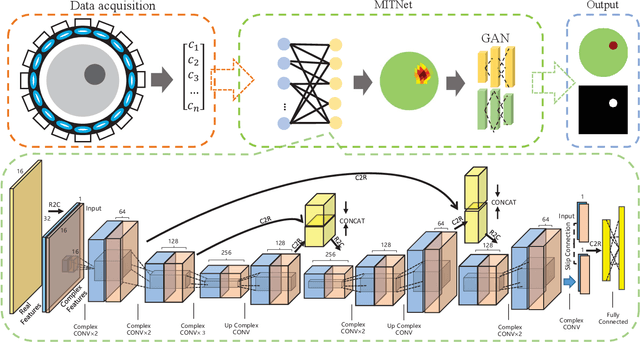
Magnetic induction tomography (MIT) is an efficient solution for long-term brain disease monitoring, which focuses on reconstructing bio-impedance distribution inside the human brain using non-intrusive electromagnetic fields. However, high-quality brain image reconstruction remains challenging since reconstructing images from the measured weak signals is a highly non-linear and ill-conditioned problem. In this work, we propose a generative adversarial network (GAN) enhanced MIT technique, named MITNet, based on a complex convolutional neural network (CNN). The experimental results on the real-world dataset validate the performance of our technique, which outperforms the state-of-art method by 25.27%.

Equivariant neural networks for inverse problems
Feb 23, 2021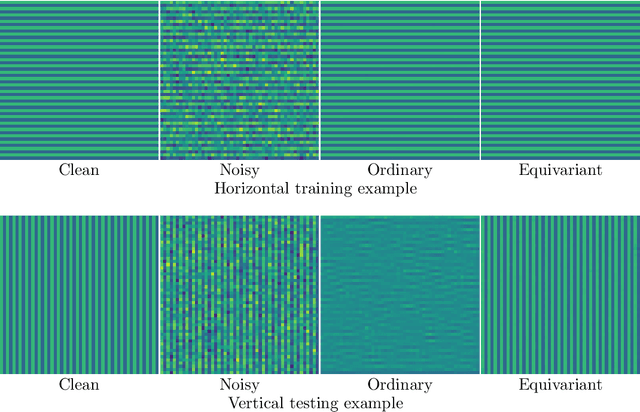
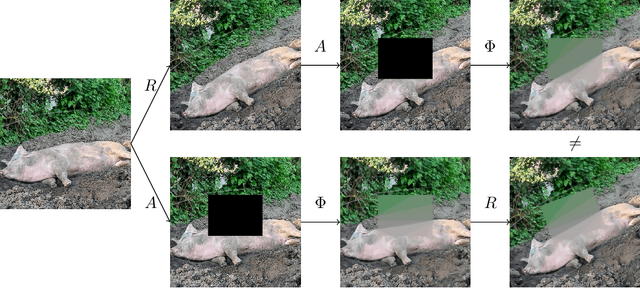
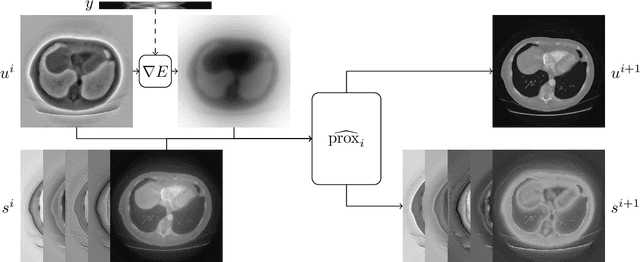
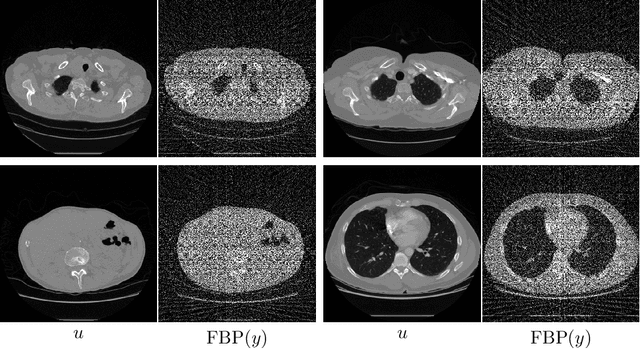
In recent years the use of convolutional layers to encode an inductive bias (translational equivariance) in neural networks has proven to be a very fruitful idea. The successes of this approach have motivated a line of research into incorporating other symmetries into deep learning methods, in the form of group equivariant convolutional neural networks. Much of this work has been focused on roto-translational symmetry of $\mathbf R^d$, but other examples are the scaling symmetry of $\mathbf R^d$ and rotational symmetry of the sphere. In this work, we demonstrate that group equivariant convolutional operations can naturally be incorporated into learned reconstruction methods for inverse problems that are motivated by the variational regularisation approach. Indeed, if the regularisation functional is invariant under a group symmetry, the corresponding proximal operator will satisfy an equivariance property with respect to the same group symmetry. As a result of this observation, we design learned iterative methods in which the proximal operators are modelled as group equivariant convolutional neural networks. We use roto-translationally equivariant operations in the proposed methodology and apply it to the problems of low-dose computerised tomography reconstruction and subsampled magnetic resonance imaging reconstruction. The proposed methodology is demonstrated to improve the reconstruction quality of a learned reconstruction method with a little extra computational cost at training time but without any extra cost at test time.
Implementation of Radon Transformation for Electrical Impedance Tomography (EIT)
Oct 16, 2012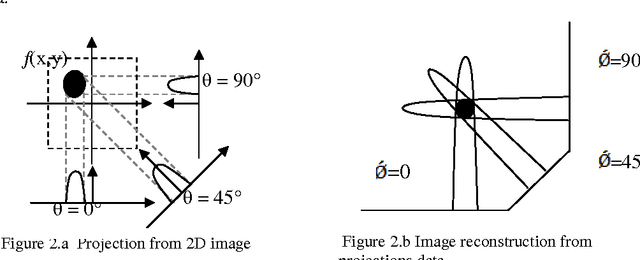
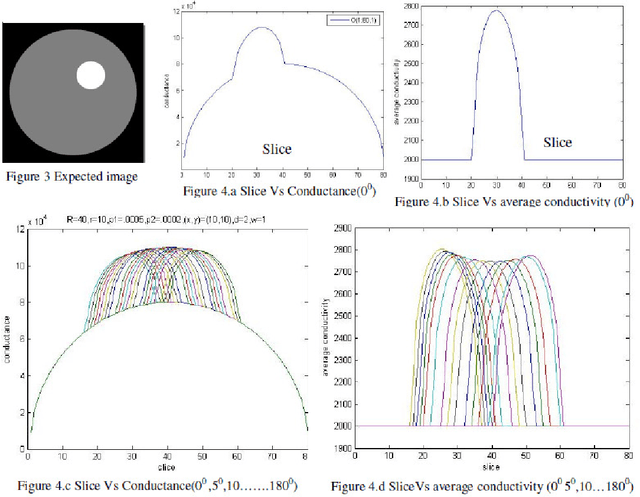
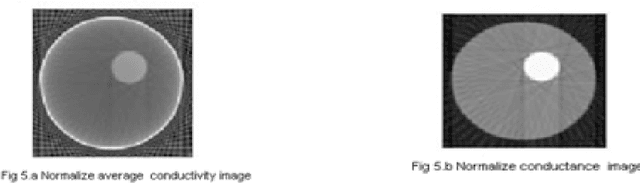
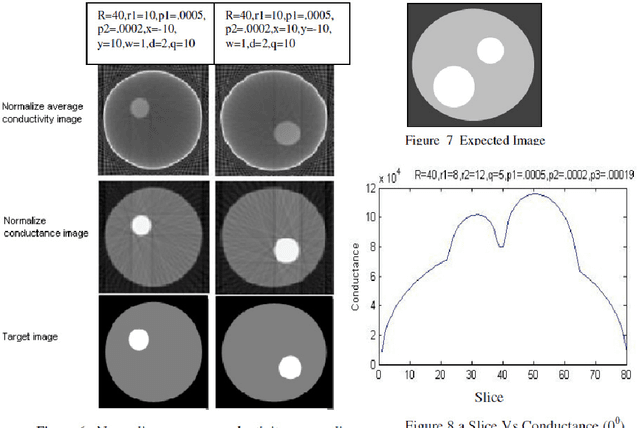
Radon Transformation is generally used to construct optical image (like CT image) from the projection data in biomedical imaging. In this paper, the concept of Radon Transformation is implemented to reconstruct Electrical Impedance Topographic Image (conductivity or resistivity distribution) of a circular subject. A parallel resistance model of a subject is proposed for Electrical Impedance Topography(EIT) or Magnetic Induction Tomography(MIT). A circular subject with embedded circular objects is segmented into equal width slices from different angles. For each angle, Conductance and Conductivity of each slice is calculated and stored in an array. A back projection method is used to generate a two-dimensional image from one-dimensional projections. As a back projection method, Inverse Radon Transformation is applied on the calculated conductance and conductivity to reconstruct two dimensional images. These images are compared to the target image. In the time of image reconstruction, different filters are used and these images are compared with each other and target image.
* 12 pages